
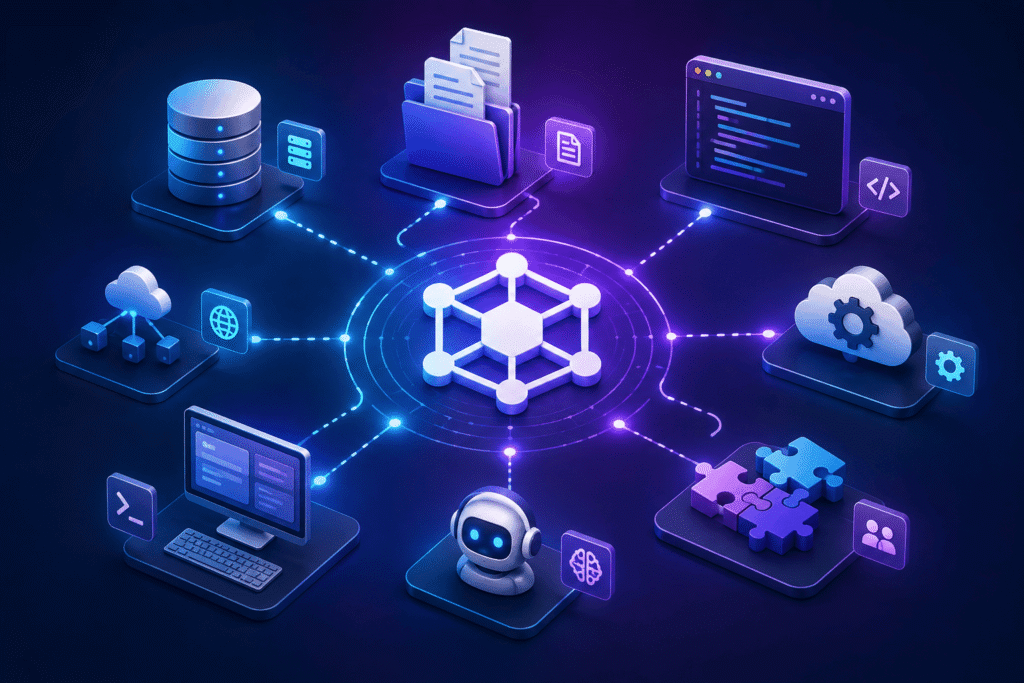
Over the past few years, Large Language Models (LLMs) have evolved rapidly. Today, models such as ChatGPT, Claude, and Gemini can answer questions, generate code, and produce high-quality content.
However, there is an important limitation: by default, these models cannot access databases, query internal systems, or interact with external tools.
This is where the Model Context Protocol (MCP) comes in.
MCP is becoming one of the most promising technologies for AI applications in 2026. It provides a standardized way to connect language models with different data sources and applications, allowing AI agents to perform tasks that go far beyond simple conversations.
In this article, we’ll explore seven practical applications of MCP.
1. Querying Databases
One of the most useful applications of MCP is allowing AI agents to query databases.
Instead of relying only on information contained in the model’s training data, an agent can retrieve up-to-date information directly from SQL or NoSQL databases.
Imagine asking:
“What were the five best-selling products this month?”
The agent can query the database in real time and return an answer based on the latest available information.
2. Reading Documents Automatically
Companies store thousands of documents, contracts, manuals, and internal procedures.
With MCP, an agent can access these files whenever necessary to answer questions or generate summaries.
This makes it possible to build enterprise assistants that can leverage an organization’s internal knowledge without relying exclusively on the model’s built-in knowledge.
3. Managing Local Files
Another interesting application is file management.
An AI agent can create folders, locate documents, organize files, move content between directories, and automate tasks related to the operating system.
This type of integration significantly expands the possibilities for AI-powered automation.
4. Integrating APIs and External Services
Most modern applications depend on APIs.
With MCP, agents can interact with external services to retrieve information, send data, or perform operations across different platforms.
For example, an agent could access weather services, query a CRM system, update spreadsheets, retrieve financial indicators, or interact with project management tools.
In practice, the model goes beyond simply answering questions and becomes capable of taking action.
5. Automating Internal Systems
Companies often have repetitive processes involving several different systems.
Using MCP, AI agents can connect these applications and automate entire workflows.
They can process requests, update records, retrieve corporate information, and perform administrative tasks without constant manual intervention.
This can reduce errors and significantly increase productivity.
6. Controlling Local Tools
MCP can also allow AI agents to interact with applications and tools installed on a local computer.
Agents can execute scripts, manipulate files, perform data analysis, and interact with specific tools used by a team.
This transforms an AI agent into a true assistant capable of interacting directly with the user’s working environment.
7. Connecting Multiple Agents
One of the most advanced applications of MCP involves communication between specialized agents.
Imagine one agent responsible for researching information, another for analyzing documents, and a third responsible for preparing reports.
Each agent performs a specific task and shares its results with the others.
This type of architecture makes it possible to build much more robust and scalable systems for solving complex problems.
Why Is MCP Becoming So Important?
As companies adopt AI agents, the need for a standard way to connect language models with external tools is also growing.
The Model Context Protocol was created precisely to simplify this process.
Instead of developing a different integration for every application, developers can use a standardized protocol, making it easier to build flexible and reusable AI solutions.
This is one of the reasons why MCP is becoming such an important technology for the future of AI agents.
Conclusion
The Model Context Protocol represents an important step in the evolution of Artificial Intelligence.
By connecting LLMs with databases, documents, APIs, enterprise systems, and local tools, MCP transforms language models into agents capable of performing real-world tasks and automating complete processes.
For anyone looking to develop modern AI applications, understanding MCP is becoming an increasingly valuable skill.
Next Step
If you want to learn how to build intelligent agents, integrate LLMs with external tools, and develop enterprise AI applications using modern technologies, AI Expert Academy offers comprehensive training on Generative AI.
In LLMs and AI Agents for Business and Automation with n8n and AI Agents, you’ll learn practical concepts involving AI agents, MCP, RAG, API integrations, and business process automation.
Build intelligent agents that go far beyond chatbots and prepare yourself for the next generation of Artificial Intelligence.

I think MCP is very promising and powerful, but at the same time, I get the nagging feeling that it’s precisely the kind of area where we’re going to lose control over AI. But then again, I’m just a simple soul. 😉
Thanks for your comment 🙂