
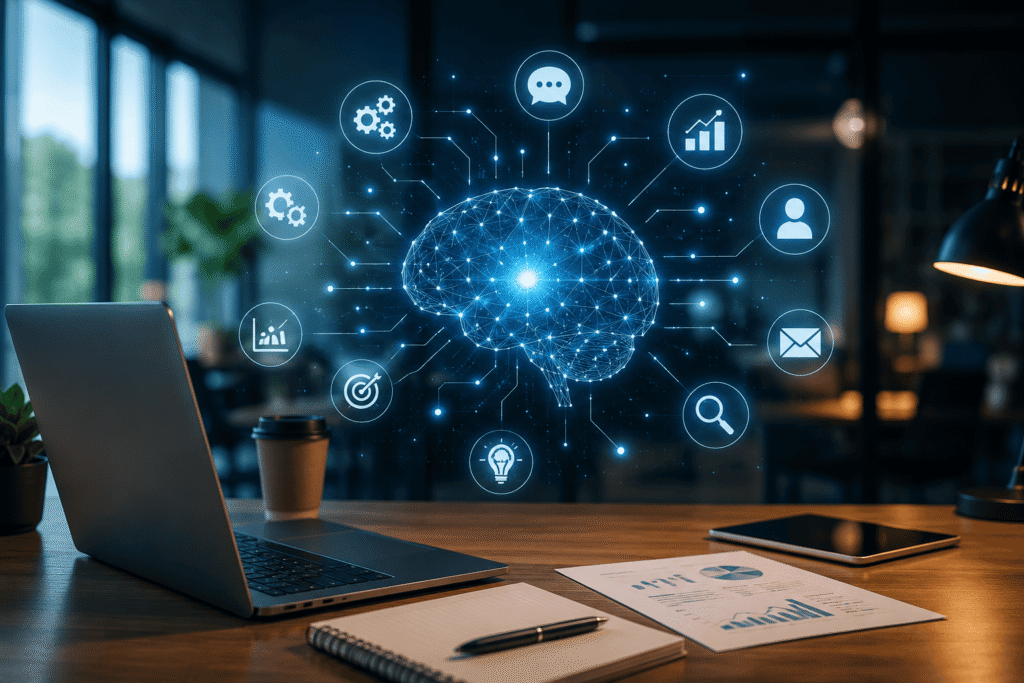
Artificial Intelligence is changing the way people work much faster than most professionals realize. Just a few years ago, AI was mainly associated with research labs, advanced engineering teams, and highly technical projects. Today, however, AI tools are becoming part of everyday work across multiple industries, helping professionals improve productivity, automate repetitive tasks, and make better decisions in less time.
One of the biggest changes happening right now is that AI is no longer limited to programmers or data scientists. Professionals in areas such as marketing, finance, human resources, customer support, project management, education, and operations are already using AI-powered tools in their daily routines. Tasks that previously required hours of manual work can now be completed in minutes with the assistance of generative AI systems and intelligent automation platforms.
This shift is creating a new type of productivity advantage. Professionals who learn how to integrate AI into their workflows are becoming significantly more efficient than those who continue relying only on traditional methods. The difference is not necessarily about replacing people with AI, but rather about enabling people to work faster, organize information more effectively, and focus on higher-value activities instead of repetitive operational tasks.
One practical example is the growing use of AI for content generation and summarization. Many professionals now use AI tools to create drafts of reports, summarize meetings, organize notes, generate presentations, and even assist with communication. Instead of starting from a blank page, professionals can use AI to accelerate the initial stages of their work and spend more time reviewing, improving, and refining the final result.
Another major impact of AI can be seen in decision-making processes. Companies increasingly rely on intelligent systems to analyze large amounts of information, identify patterns, and generate insights that would be difficult to detect manually. Even professionals without advanced technical backgrounds are beginning to use AI-assisted analytics tools to support business decisions and improve operational efficiency.
Project and task management are also evolving rapidly with the help of AI. Intelligent assistants can now help organize schedules, prioritize activities, automate reminders, and optimize workflows. Teams are beginning to adopt AI tools not only to improve individual productivity, but also to enhance collaboration and coordination between departments.
At the same time, AI is changing the skills that modern professionals need to develop. Technical expertise remains important, but adaptability, critical thinking, and the ability to work effectively alongside AI systems are becoming increasingly valuable. Understanding how to use AI responsibly and strategically may soon become a core professional skill in many industries.
Of course, AI is not perfect and still requires human supervision. Generated information must be reviewed carefully, decisions should not rely entirely on automated systems, and professionals must continue developing domain knowledge and analytical thinking. However, ignoring the impact of AI is becoming increasingly risky in a world where organizations are rapidly adopting intelligent technologies to remain competitive.
The reality is that AI is gradually becoming part of normal daily work. Professionals who start learning and experimenting with these technologies today will likely be much better prepared for the future of work than those who wait too long to adapt. The goal is not simply to understand AI theoretically, but to learn how to apply it in practical and meaningful ways that improve productivity, creativity, and decision-making in real-world environments.
At AI Expert Academy, we continue exploring practical applications of Artificial Intelligence, productivity tools, and real-world AI learning paths for professionals who want to stay updated in this rapidly evolving field.
