
Aqui está a tradução para inglês do artigo do IA Expert Academy que você indicou (de 18 de fevereiro de 2026):
The First AI Factory in Europe and the New Chapter for the Intelligent Industry
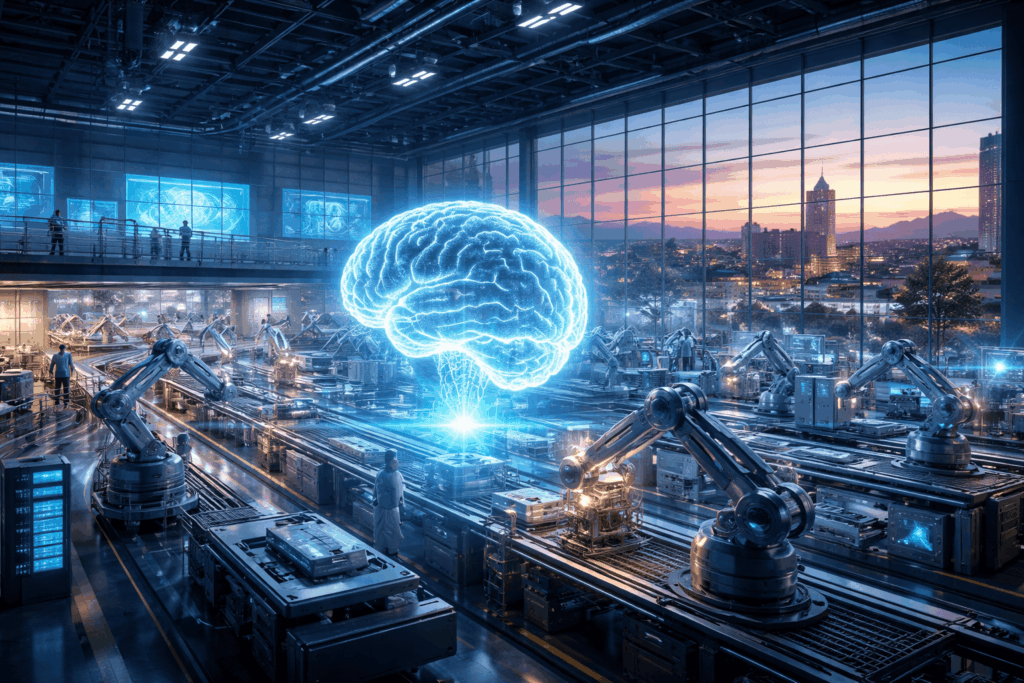
The inauguration of the first artificial intelligence factory focused on industry in Europe marks a symbolic moment in the digital transformation of the manufacturing sector. Installed in Munich, Germany, the initiative led by Deutsche Telekom represents more than a new technological center; it signals a structural shift in how industrial companies begin to develop, test, and scale AI-based solutions.
The concept of an “AI factory” does not refer to traditional manufacturing but rather to an environment designed to accelerate the lifecycle of intelligent applications, allowing algorithms, models, and autonomous systems to be created, trained, and deployed at enterprise scale.
This movement emerges in a context where AI adoption is no longer experimental and starts to occupy a strategic position in industrial operations. Companies face simultaneous pressures for efficiency, cost reduction, supply chain resilience, and sustainability, and artificial intelligence appears as a technology capable of acting across all these fronts.
By concentrating infrastructure, data, computing capacity, and expertise in a single ecosystem, the new facility lowers technical and financial barriers that have historically hindered advanced AI projects, especially for organizations without large internal data science teams.
Beyond technological impact, there is also a significant economic and competitive effect. The creation of a dedicated AI hub strengthens Europe’s positioning in an increasingly contested global landscape, where the United States and China are rapidly advancing in automation, machine learning, and intelligent systems.
By investing in specialized infrastructure, Europe seeks not only to keep up with this race but also to shape standards for safety, privacy, and governance, which have traditionally characterized the European regulatory environment. In this sense, the AI factory functions as an innovation catalyst aligned with the region’s strategic values.
Another crucial aspect is implementation speed. AI projects often run into challenges with integration, data quality, and scalability. An environment specifically designed for industrial applications allows use cases such as predictive maintenance, automated inspection, process optimization, and demand forecasting to be developed with less friction.
This shortens the path from proof of concept to actual value generation—a decisive factor in justifying investments and expanding adoption within organizations.
The initiative also highlights a cultural shift in how technology is used. Artificial intelligence starts to be treated as basic infrastructure, similar to cloud computing or connectivity, rather than an isolated or experimental project. This vision tends to boost a broader ecosystem of partners, developers, and industries, creating a network effect in which solutions, tools, and best practices spread more rapidly.
The result is an environment favorable to continuous innovation, in which AI organically integrates into business operations. In the long run, the relevance of an industrial AI factory will not only lie in the models created but in its ability to transform companies’ operational logic. As intelligent systems become central to decision-making and process automation, organizations gain agility, precision, and adaptability to volatile scenarios.
The inauguration in Munich suggests that this future has already begun to materialize, indicating that AI is no longer a distant promise but an increasingly present gear in contemporary industrial dynamics.
